


Cats might not speak our language, but they are constantly communicating with us.
Their eyes, ears, tail, posture, facial expressions and sounds can all give us clues about how they are feeling.
The tricky part? Cats don't have a single universal "language". The same behaviour can mean different things depending on the situation, the individual cat and what else is happening around them.
So let's decode some of the most common cat signals.
👀 What Are Your Cat's Eyes Saying?
😌 Slow blinking
Your cat looks at you and slowly closes their eyes.
This is generally a relaxed, friendly behaviour and can be a sign that your cat feels comfortable around you.
Try it yourself: slowly blink back.
You might just be having a little conversation without saying a word.
👁️ Wide, alert eyes
Large, attentive eyes can mean your cat has become interested in something.
A new sound, movement, unfamiliar person or another animal may have caught their attention.
Look at the rest of their body language before deciding what they are feeling.
👀 Dilated pupils
Large pupils can occur when a cat is excited, frightened, highly stimulated or playing.
The context matters.
👂 The Ears Have It
A cat's ears can change position remarkably quickly.
🟢 Ears forward
Usually means your cat is interested and paying attention to something.
Perhaps they've heard something you haven't.
🟡 Ears turned sideways
Your cat may be uncertain, uncomfortable or processing what's happening around them.
Watch what happens next.
🔴 Ears flattened backwards
Flattened ears can indicate fear, stress, anger or defensiveness.
This is usually a good time to give your cat some space.
🐈 The Cat Tail Translator
Your cat's tail can be one of the easiest things to watch — but again, it needs to be considered alongside the rest of their body language.
⬆️ Tail held upright
A relaxed upright tail is often associated with friendly social interaction.
Your cat may be saying:
"Hello!"
🐾 Tail flicking
A flicking or swishing tail can mean excitement, irritation or overstimulation.
If you're patting your cat and the tail suddenly starts moving more vigorously, it may be time to give them a break.
💨 Fluffed-up tail
A puffed-up tail is often associated with fear, surprise or feeling threatened.
Your cat is trying to make themselves look bigger.
⬇️ Tail tucked or held close
A lowered or tucked tail can occur when a cat feels nervous, frightened or uncomfortable.
Look at their ears, posture and surroundings for more clues.
❤️ What Does It Mean When Your Cat Rubs Against You?
That familiar head bump or body rub is one of the lovely ways cats interact with people.
Cats have scent glands around areas including their cheeks and head, so rubbing can be part of normal social and scent-marking behaviour.
It can also simply be a friendly greeting.
Either way, when your cat walks up and gives you a little head bump, it's hard not to feel special.
🐾 Why Does My Cat Knead?
The famous "making biscuits" behaviour.
Some cats knead blankets, beds — and sometimes their favourite person.
Kneading is commonly associated with comfort and relaxation and originates from kitten behaviour during nursing.
If your cat settles down beside you and starts making biscuits, they're probably feeling pretty comfortable.
Just watch those claws!
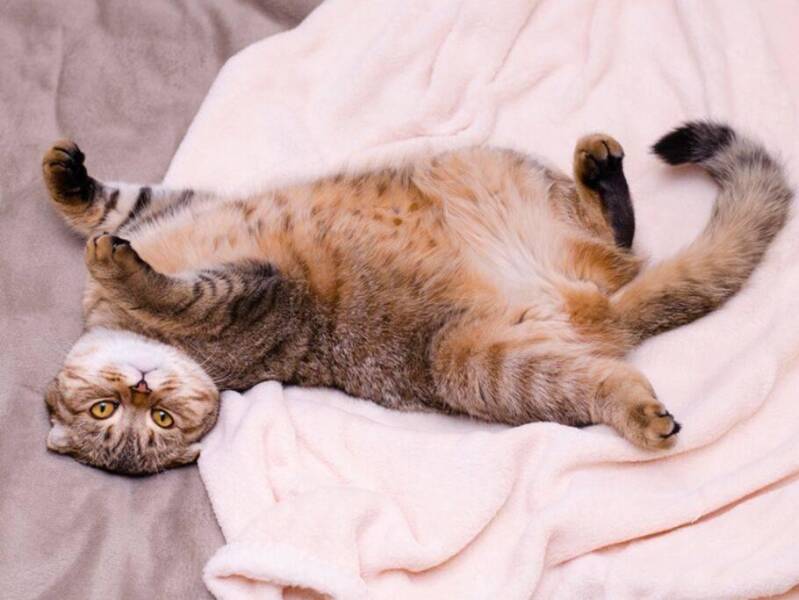
😺 Why Does My Cat Show Me Their Belly?
This one catches many cat owners out.
A cat lying on their back and showing their belly can indicate that they feel relaxed or are displaying trust.
But...
It doesn't necessarily mean: "Please rub my belly."
Many cats will happily expose their belly and then immediately grab your hand if you touch it.
Consider yourself warned.
🔊 What Is Your Cat Saying?
Cats have an impressive collection of sounds.
😸 Meow
Adult cats primarily use meowing to communicate with people.
Different cats develop different meows, and they can use them to seek attention, ask for something or respond to interaction.
😺 Purr
Purring is often associated with contentment.
However, cats can also purr in other situations, including when they are stressed or uncomfortable.
That's why purring shouldn't automatically be interpreted as "everything is fine".
🐦 Chirping or chattering
Some cats make little chirping or chattering sounds when watching birds or other interesting things.
It can be fascinating to watch — especially when they're sitting at a window completely captivated by what's happening outside.
😾 Hissing
A hiss is generally a clear warning that your cat is uncomfortable, frightened or wants you to back off.
Listen to the message.
Give your cat space rather than trying to force interaction.
😾 Growling
Growling can also be a warning signal associated with fear, stress or aggression.
Again, space is usually the best response.
🧩 The Most Important Rule: Look at the Whole Cat
One behaviour doesn't always tell the whole story.
For example, a cat might purr because they're relaxed — but purring can also happen when a cat is stressed or uncomfortable.
Instead of looking at one signal, consider:
Eyes + ears + tail + posture + sounds + situation
Put them together and you'll get a much better idea of what your cat may be communicating.
🐱 Your Cat Is Talking — Are You Listening?
Once you start paying attention, you'll notice that your cat is communicating with you all the time.
A twitch of the tail.
A slow blink.
A head bump.
A little chirp from across the room.
These small signals can tell you a surprising amount about your cat's world.
And the more familiar you become with your individual cat, the easier it becomes to recognise what is normal for them.
❤️ A Little Reminder for Cat Owners
If your cat suddenly develops a significant change in behaviour, appetite, toileting, activity or interaction, don't simply assume they're "speaking cat".
Behaviour changes can sometimes have an underlying cause, so it's worth seeking appropriate professional advice if you're concerned.
🐾 Going Away?
Your cat doesn't need to leave home just because you do.
For many cats, staying in their familiar surroundings while someone visits to provide care can be a less disruptive option than travelling to a new environment.
At Paws And Beyond, we provide caring pet visits across Penrith and surrounding Western Sydney areas, helping pets stay comfortable in their own homes while their owners are away.
Because sometimes the best place for a cat is right where they feel safest — at home.
Add comment
Comments